
If Rest Has Not Fixed It and Pushing Through Has Not Fixed It, You Are Not Doing It Wrong
You have probably been told both. Rest it, then push through it. Neither works for pain that has been around longer than a few months, because pain that persists is not the same problem as pain from a fresh injury. It needs a different approach entirely.
Australians live with chronic pain
Across every age group, including children
Cost to the economy each year
At minimum, on current estimates
Of early retirements are due to back pain
Back pain specifically, not all chronic pain
Almost Everyone Walks In With One of These Three Problems
After sixteen years of this, the patterns are fairly predictable. See if one of them sounds like your last twelve months.
You are confused about what to do
Too much conflicting advice, and a real fear of making it worse. So you either do nothing, or you do something random and hope. Neither builds anything.
You keep falling off track
A few good weeks, then a flare, a busy stretch, a sick kid, and it unravels. You have been here before, which is the part that grinds you down.
You stop and start
Feel alright, go hard, pay for it, rest completely, feel alright again. Repeat. Plenty of suffering in both directions and no actual progress.
The Stop Start Cycle, Drawn Out
This is the single most useful thing I can show someone in a first consult. Tap between the two to see the difference. Note that the red line has bigger days than the green line, and still ends up going nowhere.
The red line is not laziness and it is not a lack of willpower. It is what happens when the only feedback you have is how you feel today. On a good day you do everything you have been putting off, and the flare arrives two days later. The green line feels underwhelming for the first fortnight, and then it quietly overtakes.
Which One Sounds Most Like You
Open the one that fits. Each has a different starting point, which is why generic exercise lists do not get people very far.
A"I want to move but I am scared I will make it worse."
Your problem is not motivation, it is information. You need to know what is safe, and you need someone to put a number on it rather than telling you to listen to your body when your body has been lying to you for two years.
The first session is mostly assessment. We work out what you can do today without a flare, and that becomes your baseline. It is almost always more than you expect, and it is done in a controlled way so you can prove it to yourself.
B"I start well, then something derails me and I never get back to it."
You do not need a better program. You need a program that survives a bad week. Most plans are built for the version of you that has time, energy and no symptoms, which is not the version that shows up in week five.
This is also where hands on treatment earns its place. Regular massage keeps tension from building to the point where it takes you out for a week. It is maintenance, not luxury, and it is the difference between a setback and a full reset.
C"On a good day I overdo it, and then I pay for it for three days."
You are the red line on the chart above. The instinct to cash in a good day is completely understandable, and it is also the single biggest thing holding you back.
The fix is pacing, which sounds boring and is genuinely difficult. It means doing less than you could on your best days so that you still have something left on your worst ones. Done properly it feels frustrating for about three weeks and then it starts working.
Three Things, and They Work Together
Exercise is the most effective single thing available for chronic pain. It is also the thing most likely to be prescribed badly. Here is how we structure it, and what each part is actually for.
Move with strength
Resistance training, done at a load your body can currently handle, progressed deliberately. This is the part that changes things structurally. Stronger muscles support joints, take load off irritated tissue, and give you a body that tolerates more of ordinary life.
- Start well below what you think you can do, so the first fortnight is a guaranteed win
- Two sessions a week beats five sessions for two weeks and then nothing
- Write the numbers down, because progress in chronic pain is too slow to notice by feel
- Machines, bands or bodyweight are all fine. The load matters, the equipment does not
Reset and release
Hands on treatment plus things you do at home. Remedial massage reduces muscle tension, improves circulation and, more usefully, changes what you feel. That matters because pain that has been around a long time is partly a sensitivity problem, and changing the input changes the output.
- Regular treatment keeps tension from accumulating into a flare that costs you a week
- Self massage and daily release work between sessions does most of the heavy lifting
- Low intensity movement on sore days is better than complete rest, almost every time
- Walking, cycling and swimming all count, and the best one is the one you will actually do
Recover like a pro
Pacing, sleep and planned rest. This is the least glamorous pillar and it is the one that decides whether the other two survive contact with real life. Rest because you planned it, not because you crashed.
- Cap your good days on purpose. This is the hardest instruction I give anyone
- Sleep is where recovery happens. Poor sleep makes pain worse the following day, reliably
- Plan the rest day before you need it, and put it in the calendar like an appointment
- Learn your own early warning signs, so you can pull back a day before the flare, not a day after
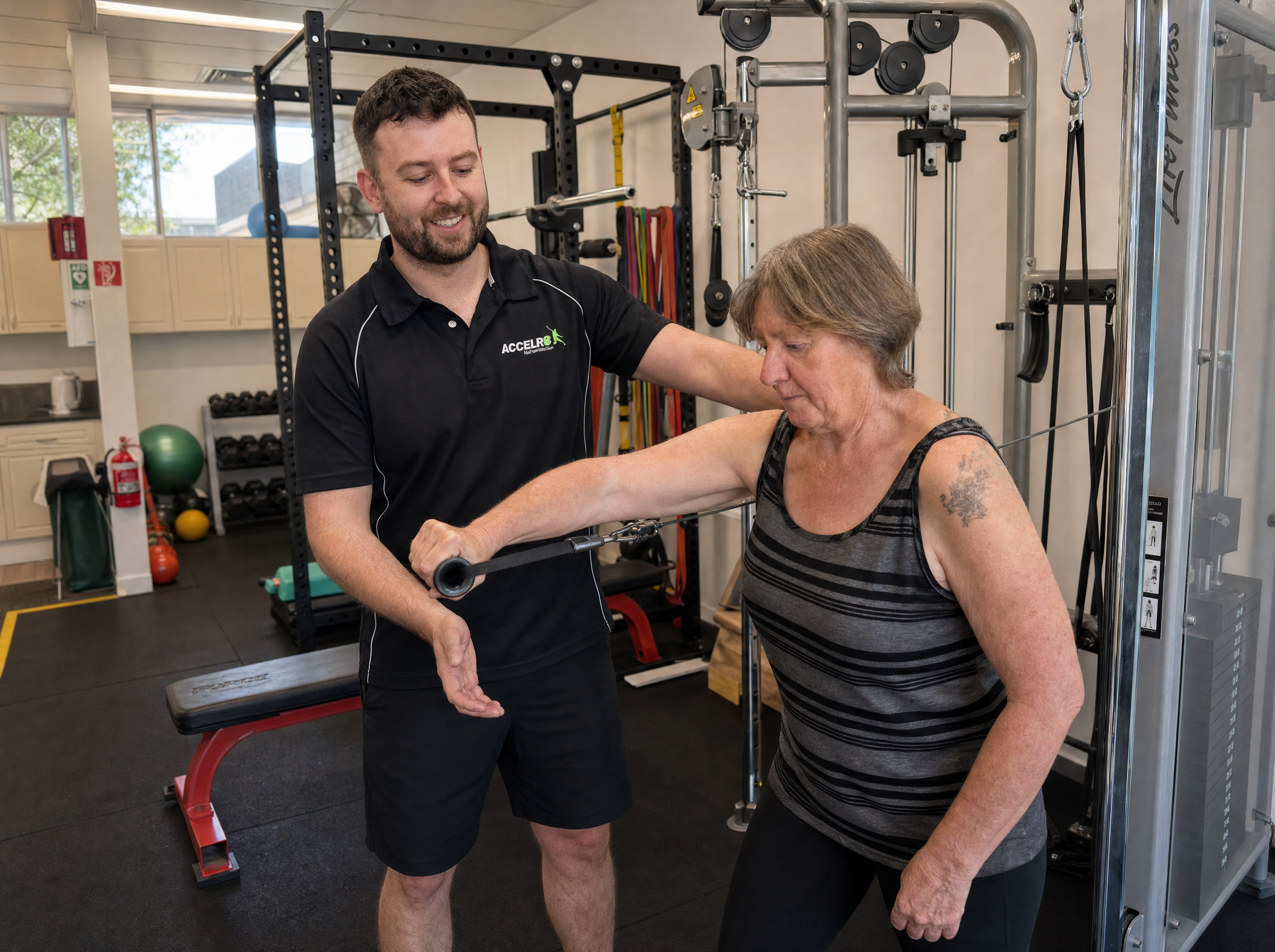
Exercise and Hands On, Delivered Together
Most clinics do one or the other, so the two halves of your treatment never talk to each other. Doing both here means the massage is informed by what your program is asking of you that week, and the program is adjusted by what I can feel in the tissue. It is a small structural difference that makes a large practical one.
Three Things You Can Start This Week
You do not need to book anything to do these. They are the same three things I ask new clients to do before their second appointment.
Find your honest baseline
Pick one activity, walking is fine. Work out how long you can do it on an average day without paying for it tomorrow. Not your best day. Your average day. That number is your starting point.
Do that amount, even on good days
For two weeks, do not exceed it. This will feel wrong. Doing it anyway is the entire skill, and it is what breaks the cycle.
Write it down
Date, what you did, how you felt the next day. Three lines. In six weeks this becomes the evidence that something is changing, which is nearly impossible to see by feel alone.
What People Ask Before They Book
Will exercise make my pain worse?
Done at the wrong load, yes. Done at the right load, no. That is the entire job, and it is why the first appointment is mostly assessment rather than exercise.
Some increase in symptoms during the first fortnight is common and is not damage. There is a meaningful difference between a body that is unaccustomed to load and a body that is being harmed, and knowing which is which is what you are paying me for.
How long before I notice anything?
Most people notice something within four to six weeks, though it is rarely the thing they expected. Sleep often improves before pain does. Confidence usually improves before either.
Meaningful change in a condition that has been around for years takes months, not weeks. Anyone promising faster than that is selling you something.
Do I need a referral?
No. You can book directly as a private client for either Exercise Physiology or Remedial Massage.
A referral helps if you want to use funding. A GP can refer you under a Chronic Disease Management plan for Medicare rebated Exercise Physiology sessions. DVA clients need a D904 from their GP. NDIS and Support at Home clients can be funded through their existing plan or budget.
Is it massage or exercise? How do I choose?
For most people with long standing pain, it is both. Massage changes what you feel in the short term, exercise changes what your body can do in the long term. Used alone, massage tends to wear off and exercise tends to be too uncomfortable to sustain.
If you are not sure, book in and we will work it out on the day. It is not a decision you need to make in advance.
I have tried physio and it did not work. Why would this be different?
It might not be, and I will tell you early if I think that is the case. What is often different is the time frame and the structure. A lot of treatment for persistent pain is delivered in short blocks built around an acute injury model, which is the wrong model for a problem that has been present for years.
The other difference is having exercise and hands on treatment delivered by the same person, so nothing gets lost between two practitioners who have never spoken.
What about yoga, pilates, tai chi and stretching?
All useful, none of them magic. They are good ways to move, and moving is the point. If you enjoy one of them, do it, because enjoyment is a genuine predictor of whether you will still be doing it in six months.
What they generally will not do on their own is build enough strength to change how much load your body tolerates. That is worth adding alongside, not instead.
If You Need More Than One Clinic
Chronic pain often needs a team. Alongside exercise and hands on treatment, some people benefit from pain specialists, psychology, or a structured multidisciplinary program.
The public option in the ACT is the Pain Management Unit at University of Canberra Hospital, run by Canberra Health Services. It takes written referrals from a GP or specialist, and runs education sessions, group planning and a multi week pain management program. Waiting times have historically been long, so it is worth asking your GP about it early rather than as a last resort.
There are also several private pain clinics in Canberra. Your GP is the right person to advise which is appropriate for your situation, since it depends heavily on what you have already tried.
Book a Time and We Will Find Your Starting Point
Bring what you have already tried, including the things that did not work. That history is useful. We are in Weetangera, Belconnen, and there is usually a short wait for a first appointment.
Prevalence, economic cost and early retirement figures: Painaustralia and the Australian Institute of Health and Welfare. The 40 per cent early retirement figure refers specifically to back pain. This article is general information and is not a substitute for individual clinical advice.